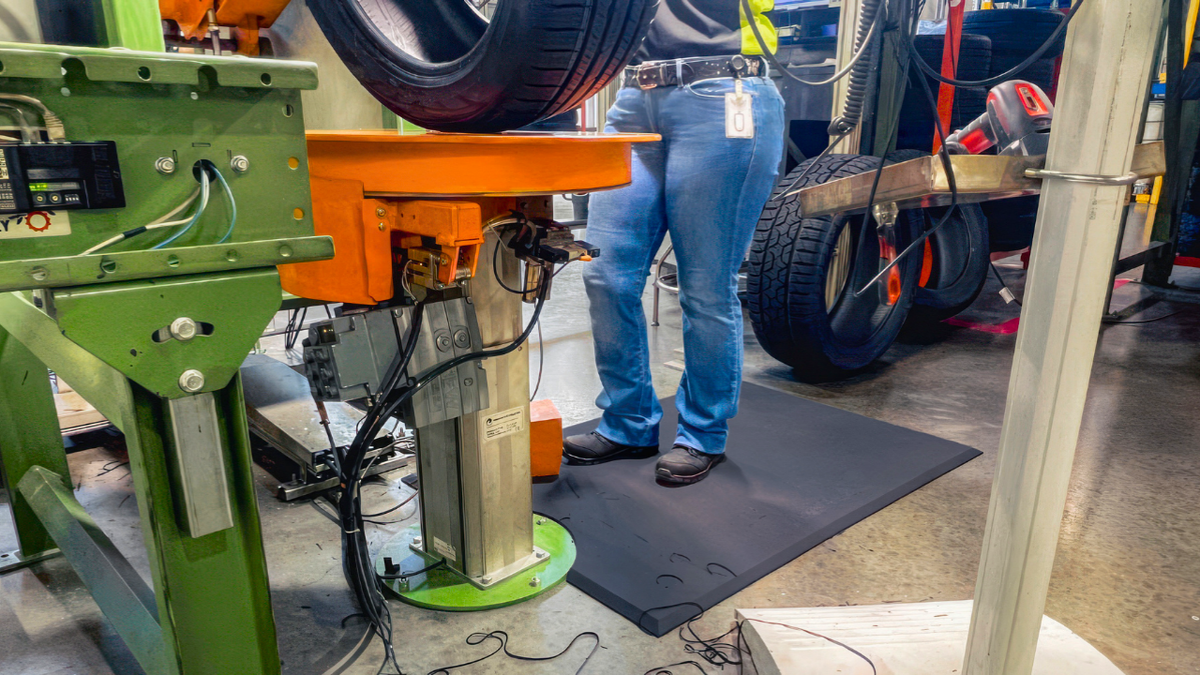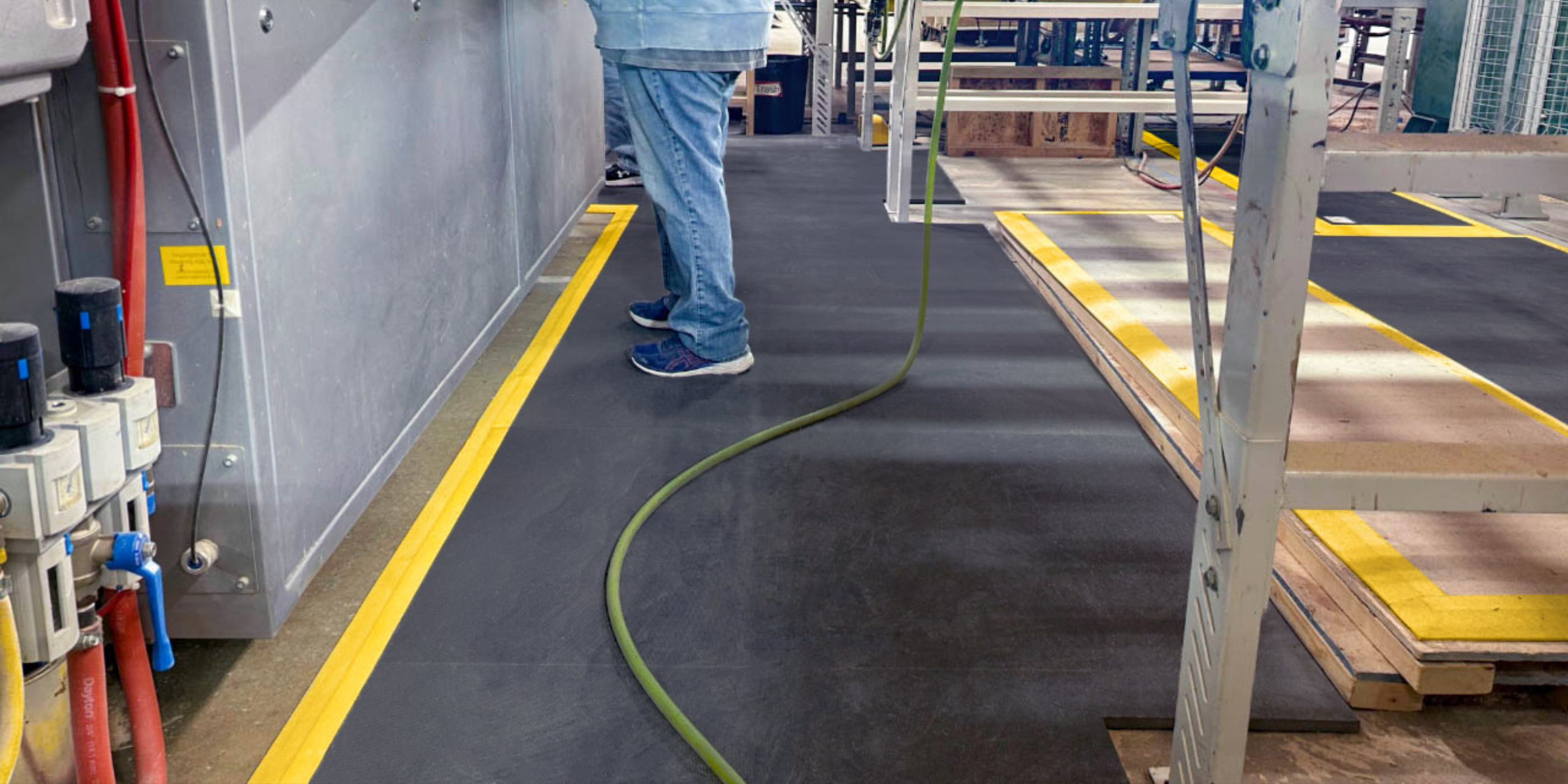



When anti-fatigue mats are the wrong shape or size, or when you piece and pile mats together to try and fit complex layouts, they don't fit your workspaces and employees end up standing along the edges. This is called edge-standing, and it's a subtle but very real injury risk.
Edge-standing is one of the easiest anti-fatigue mat safety hazards to overlook because the mats are technically present. From a distance, everything appears fine. In reality, anti-fatigue mats that don’t fit your workspaces can create the very ergonomic issues and trip hazards you initially purchased them to fix.
Below, 3 hidden dangers of anti-fatigue mat edge-standing – including insight from injury prevention specialists and ways you can put an end to edge-standing permanently.

Anti-fatigue mat edge-standing may appear innocuous at first glance, but in reality it can lead to ergonomic injuries as well as slips, trips, and falls.
Hidden Danger #1: Increased Fatigue and Non-Neutral Standing Postures
When employees stand with their feet along the edges of their mat, toes facing downward – not unlike standing in high heels with heels raised – their legs and lower back are forced into a less natural standing position that puts strain on the body.
We asked Certified Professional Ergonomist Mike Janak with ErgoFactor what happens to the human body when workers spend prolonged periods of time in this position.
According to Mike:
"Standing with only half the foot in contact with the mat promotes a non-neutral ankle posture that would be similar to standing on high heels. If the standing postures are static, and the worker stands at the edge of the mat for prolonged periods without moving his/her feet, then the non-neutral ankle posture may result in musculoskeletal (MSD) injury."
According to the National Safety Council, MSDs are the No. 1 most reported workplace injury in the world. The body works best when standing in neutral postures. When workers are forced to spend hours standing partially on a mat, the ankle, foot, and lower body are placed under additional stress – as Mike stated, this increases the risk of MSD injury.

TruStile Doors was piecing together hand-cut roll mats (left). Accordig to EHS Manager Andy Grunhovd, this caused an operator to trip over the gaps and roll his ankle – leading to workman's compensation, medical treatment, and lost production. In response, TruStile replaced all roll mats with custom AcroMat mats to fit each work cell. Read case study.
Hidden Danger #2: Reduced Stability and Increased Slip, Trip, and Fall Risks
Edge-standing doesn’t just affect ergonomics. It can also impact stability. Specifically, it increases the risk of slips, trips, and falls – the No. 2 most reported workplace injury globally.
We asked Mary Plehal, Ergonomist and Occupational Therapist with DORN, how exactly edge-standing increases the risk of slip, trip, and fall injuries.
According to Mary:
"From a musculoskeletal perspective, this can increase tarsal/metatarsal joint issues – where the foot bones meet the toe bones at the ball of the foot. This changes the biomechanics of the ankle, increasing instability and leg/low back fatigue. We are one long kinetic chain, like the old song: 'The foot bone's connected to the ankle bone, the ankle bone's connected to the leg bone, the leg bone's connected to the knee bone…' [Edge-standing] is also awkward and exposes employees to a higher risk of slips, trips, falls, and rolled ankles."
When employees are standing along the edges of their mat, or half on/half off, they are forced to constantly transition between uneven surfaces. As Mary notes, this additional movement along awkward surfaces increases the risk of slip, trip, and fall injuries.
Ergonomic injuries are more subtle and harder to recognize, but slips, trips, and falls are obvious and something you can immediately put an end to with the right solution.
EHS Manager Jake Berger with Vermeer Corporation shares how his team is preventing slip, trip, and fall injury risks – like edge-standing – across their 2,400-person campus with AcroMat's custom anti-fatigue mats designed to fit each workspace's walking path.
Hidden Danger #3: Employees Stop Using the Mat the Way It Was Intended
One of the biggest problems with edge-standing is that employees adapt. If a mat is too small, workers naturally find ways to perform their job despite the limitation.
They stand on the borders. They stand beside the mat. They position one foot on the mat and one foot on the floor. They constantly move on and off the mat to reach tools, controls, or materials. Or, they shove the mat under their desk because it’s too annoying to deal with – leading them to stand on bare concrete for hours on end.
Over time, these workarounds become normalized. Employees begin to believe, "This is just the way things are" and keep working without raising concern. Safety and production leaders aren't hearing of the issues, so they assume all is well. Once sub-par becomes status quo, it can be difficult to break free and see there is a better way.

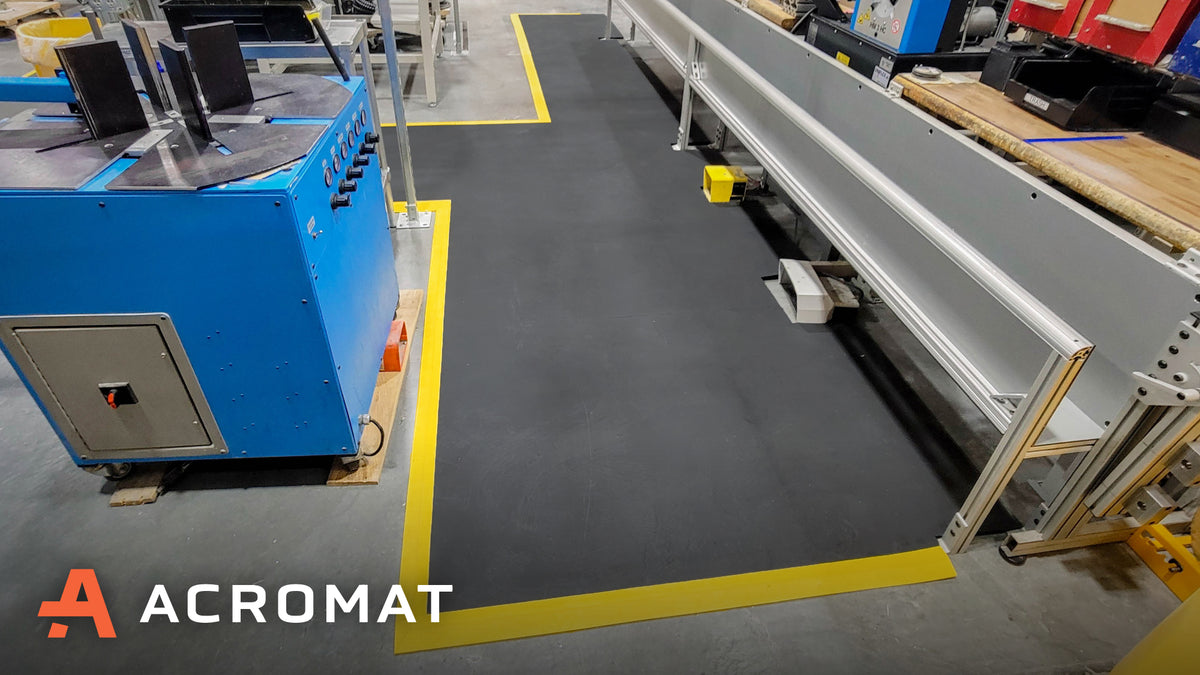
The anti-fatigue mat on the left is a quality product inside a Kwik Trip gas station. While a solid mat, because it doesn't fit the work area, it's causing more risk than reward. Employees are constantly walking over gaps and standing on the egdes. The mat on the right inside a food manufacturing facility was precisely designed to fit – including a cutout around the legs of the table to allow the mat to slide underneath several inches. This keeps the operator firmly on the even surface of the mat with no risk of edge-standing.
Related: 3 Hidden Dangers of Stacking Your Anti-Fatigue Mats
How Common is Edge-standing?
We surveyed close to 200 safety leaders over the past three years, and ~35% say they've noticed edge-standing due to poor-fitting or pieced-together mats inside their facilities.
Why Does Edge-Standing Happen?
Edge-standing occurs because organizations are forced to work within the limitations of standard-size mat catalogs. Many anti-fatigue mat providers offer only a handful of standard widths and lengths (e.g., 2' x 3', 3' x 5', 4' x 8'). If these sizes don’t fit the workspace, companies often purchase the closest available option and make it work.
The result:
- Mats that are too small
- Mats that don’t follow the workflow
- Employees standing on borders
- Multiple mats pieced together to cover a larger area
- Constant stepping on and off the mat
In fact, an additional 35% of safety, production, and continuous improvement leaders say the number one complaint they receive about the anti-fatigue mats inside their facilities is that they are "too small or the wrong shape."
When a mat is too small or the wrong shape, employees aren't just standing on the borders. They are at risk of tripping and injury. We received this footage of a female operator tripping over a mat that was too small, breaking her wrist, and missing several weeks of work. More important than the lost production and worker's compensation costs to the company, the employee was forced to deal with the emotional and physical consequences.
Related: 5 Ways Custom Anti-Fatigue Mats Help Prevent Workplace Inuries
How to Prevent Edge-Standing
The good news is that edge-standing is easily preventable. Simply put, you need anti-fatigue mats that actually fit the workflow inside of each workspace. Here are three proven ways to prevent edge-standing, including the injury risks that follow.
3 Ways to Reduce Edge-Standing
1. Design mats to fit the workspace.
Instead of forcing standard-size anti-fatigue mats into a complex layout, design your mats to seamlessly fit the workspace. The standing surface should support where employees actually stand and move throughout their work day.
With AcroMat, our custom mat builder AcroSketch gives you the ability to design any shape and size and also add custom features like cutouts, built-in cable covers, and fully customized border options. The videos below featuring Pella Windows and a Fortune 500 automotive manufacturer show a few practical examples.
5 Ways Pella Windows & Doors improved safety with AcroMat, including replacing pieced-together mats with custom mats designed to fit.
This Fortune 500 vehicle manufacturer designed a 450 sq. ft. custom AcroMat that weaves through the entire, extended workspace. As operators move back and forth each shift, they remain fully on the mat – experiencing uninterrupted comfort and traction.
It's important to note that not every facility needs large custom mats; sometimes it's as simple as replacing a 2' x 3' with a 2' x 4'. What's most important is being able to get exactly what you need, not settling for only what your anti-fatigue mat provider sells.
2. Stop piecing together mats that don't fit.
Over 40% of safety and production leaders say "having to piece together rectangular mats" to cover complex layouts is one of their main challenges with anti-fatigue mats. Disconnected mats encourage edge-standing, the individual pieces are are 'out on an island' making them more likely to slide around, and the gaps create trip hazards. This approach also leads to inconsistent thicknesses, surfaces and life expectancies.
See what's possible with our proprietary online mat building tool, AcroSketch. Learn more about the features and functionality with our video training library, How to AcroSketch.
3. Educate your team and ask for feedback.
During a recent visit to a large automotive manufacturer, I noticed an employee standing along the edge of his anti-fatigue mat. I asked if he realized he was doing it.
He laughed and said yes. The mat was just a few inches too small for the workstation, and standing on the edge was "kind of fun." It's a good reminder that people don't always recognize when they're putting themselves in awkward or unstable positions. Humans have a tendency to put themselves off balance, especially when the equipment beneath their feet encourages it. We rock in our chairs, we stand along edges, we cross our legs when sitting without realizing the strain any of these actions creates.
This is why preventing edge-standing isn't just about purchasing the right mats. It's also about awareness. Most of your team members have probably never heard the term "edge-standing" and may not realize it's affecting their stability, posture, and fatigue. Once they know what to look for, the behavior becomes much easier to identify.
Walk the production floor, watch your employees' paths, educate them on the risks of edge-standing, and ask simple questions:
- Is your mat large enough? Is it the right shape?
- Do you find yourself standing on the borders?
- Are you constantly stepping on and off the mat(s)?
- Are there areas that should be covered but aren't?
The easiest way to eliminate edge-standing is to make your people aware of it. Start with education and awareness, listen and learn from your people, walk the floor to identify where it's happening, and from there make a plan to banish it from your facilities.
Interested in comparing AcroMat to the anti-fatigue mats you use now? Connect with our team any time for a free, full-sized trial mat. Simply click Request Your Free Mat below.
About the Author: Rich Ward
Rich leads the AcroMat marketing team, supports R&D, and is the architect behind the AcroMat brand. His focus is on providing clear, honest, and highly researched information to help our customers make confident buying decisions. You’ll often find Rich on industrial podcasts, LinkedIn and other channels sharing the industrial marketing and anti-fatigue mat insight and practical tips he learns from constantly researching, testing and trialing our products.