


Anti-fatigue mats should be inspected regularly and replaced when they can no longer provide a safe, supportive standing surface. Because anti-fatigue mat lifespan varies by material, environment, traffic, and use, there is no universal replacement schedule. A mat that has been in use for 6 months and already curling along the borders should be replaced immediately, while a mat that's 5 years old with no sign of curling may have years of useful life left.
Instead of replacing anti-fatigue mats based strictly on age, it's important to evaluate them based on how they are performing.
For most workplaces, we recommend inspecting your mats at least once every 30, 60, or 90 days. Settings where mats are exposed to oils, chemicals, cart traffic, dropped parts, and constant shifts require more frequent attention. The most important thing isn't how often. It's that you develop a formal cadence, have a process in place, and ensure it's being followed.
This article explores why inspection is important, tips for creating a scalable process, recommended cadence, and what to look for when inspecting your anti-fatigue mats.
In This Article:
- What Research Says About Anti-Fatigue Mat Inspection
- How Often Should Anti-Fatigue Mats Be Inspected?
- What Should You Look for During an Anti-Fatigue Mat Inspection?
- Don't Just Inspect the Mat. Inspect the Workspace.
- How Long Should an Anti-Fatigue Mat Last?
- When Should an Anti-Fatigue Mat Be Replaced?
- Take Pictures and Track Changes Over Time
- Ask the People Standing On the Mats
- Start With a Monthly Safety Walk
- Frequently Asked Questions About Anti-Fatigue Mat Inspection
What Research Says About Anti-Fatigue Mat Inspection
Companies routinely review and inspect PPE, ear plugs, glasses, forklifts, machinery, fire extinguishers, and other pieces of workplace safety equipment. However, they rarely spend dedicated time carefully reviewing their anti-fatigue mats.
As part of AcroMat's 2027 State of Industrial Anti-Fatigue Mats report, I surveyed 135 EHS, manufacturing, and continuous improvement leaders. 47% percent of these leaders say they "do not have a formal anti-fatigue mat inspection process in place." Only 24% inspect their anti-fatigue mats on a monthly basis.
Further, 52% of these same leaders expect their anti-fatigue mats to last at least 2 years, yet 70% say their mats are lasting for less than 1 year.

2027 State of Industrial Anti-Fatigue Mats: Nearly 50% of safety, manufacturing and continuous improvement leaders say their companies do not have a formal anti-fatigue mat inspection process, according to AcroMat's 2027 State of Industrial Anti-Fatigue Mats report.
Additional data from AcroMat's 2027 State of Industrial Anti-Fatigue Mats report:
- 53% of EHS, manufacturing, and continuous improvement leaders inspect their anti-fatigue mats just once a year or not at all.
- Only 24% of EHS, manufacturing, and continuous improvement leaders inpect their anti-fatigue mats at least monthly.
How Often Should Anti-Fatigue Mats Be Inspected?
One of the best anti-fatigue mat inspection processes we've encountered came from an AcroMat customer, a Fortune 500 industrial manufacturing company. Here's what the Corporate EHS Manager shared with me during a recent conversation:
"We dedicate an operator to walk the floor once a month and make note of any trip, slip, fall, or ergonomic hazards that are clear to the eye. This was part of our Lean 5S Stretch Goals, created to give employees the opportunity to stretch beyond their usual roles and as an opportunity to increase collaboration. We rotate employees every few months to give all team members the opportunity."
There are four key reasons this approach works, and why it's one you should consider integrating into your inspection process.
I. There is Formal Cadence
The inspection happens once a month, so there's a defined cadence. This can be at the beginning of the month, on the last day of the month, when lines are on break, whenever works best for your team. At AcroMat, we recommend every 30 days, 60 days, or 90 days.
II. Inspection Has Been Assigned
The inspection is assigned to a specific person, so responsibility doesn't fall into the ambiguous category of "someone should probably check on that." Whether you lead this process or assign to someone else, the key is that it's assigned.
III. All Team Members Get an Opportunity to Participate
The responsibility rotates between employees, giving different people the opportunity to stretch beyond their day-to-day roles. This approach helps build a culture of safety, and ensures your facility is looked at with fresh eyes each month.
IV. The Process is Simple
Lastly and most importantly, the process isn't complicated. Someone walks the floor and looks at the mats in use, and they have a checklist showing them what to look for. The simple act of walking and looking can uncover a surprising number of preventive problems.
Build the process, follow it, and fold it into your strategic safety program.

Fortune 500 Corporate EHS: When asked about their anti-fatigue mat inspection process, this industry leader shared that they dedicate an operator to walk the floor once each month.
What Should You Look for During an Anti-Fatigue Mat Inspection?
You don't need sophisticated testing equipment or a highly complex process to identify the most common anti-fatigue mat problems.
Start by looking for:
- Curling or raised edges that could create a trip hazard
- Sliding or migrating mats that won't stay in their intended position
- Flattening or lost cushion that may reduce ergonomic support
- Rips, tears, or divots in surfaces that can impact traction
- Gaps between mats that employees repeatedly step across
- Overlapping or stacked mats which can create ergonomic issues
- Exposed cords or cables that can trip up fast-moving workers
- Mats that don't properly fit, causing half on/off standing or edge-standing
- Mats being flipped upside down to hide damage or diminished cushion

Example 1: The anti-fatigue mat on the left is aggressively curling. The cushion underneath the mat has buckled and shrunk, lifting the borders off the ground. Curling is a dangerous trip hazard, meaning the mat now needs to be replaced. The AcroMat NitriTuf Diamond Series mat on the right is lying flat, and the cushion is fully intact. It has multiple years of use left.

Example 2: The mats on the left are in excellent shape. They are lying flat with great cushion. The problem is, they are pieced together, leading to edge-standing, on/off stepping, and sliding around – all ergonomic risks and trip hazards. The custom AcroMat 100-1 Series mat on the right fits the area like a glove, preventing sliding. The custom shape also ensures the operator remains fully on the mat when moving back and forth.
Looking for a simple tool to get started? Access our Anti-Fatigue Mat Performance Snapshot Checklist. This digital and printable checklist highlights eight of the most common mat-related safety hazards to help guide your initial inspections. If any of these issues are present in your facility, your mats may be putting users at risk and require a closer, more detailed review.
Don't Just Inspect the Mat. Inspect the Workspace.
A mat doesn't have to be damaged to be wrong. Maybe your workstation was rearranged, and the 3 ft. by 5 ft. mat that previously fit no longer does. Now, it's a trip hazard or slows productivity. In the video below, I share how an operator broke her wrist because her anti-fatigue mat wasn't designed to fit her day-to-day movements.
Rather than strictly looking at the mat itself, always consider the work area where the mat is used. An anti-fatigue mat can be in perfectly good condition and still need to be replaced or redesigned if it doesn't fit the workspace.
What's Wrong With Your Anti-Fatigue Mat? In this 3-minute video, I share why a 3. ft. by 5 ft. mat that is in good shape and lying flat was actually a trip hazard that caused serious injury.
Related: 5 Ways Custom Anti-Fatigue Mats Prevent Injury Risks
How Long Should an Anti-Fatigue Mat Last?
There isn't one universal answer. The useful life of an anti-fatigue mat depends entirely on how it performs over time. Performance and longevity depend on material, construction, environment, traffic, exposure to liquids and chemicals, cleaning practices, and how many hours the mats are used each week.
When asked questions like, "How much longer will my anti-fatigue mat last?" or "Is this mat still in good shape?", we encourage AcroMat customers and non-customers alike to ask whether their mats are still performing the functions they were purchased to perform.
1. Is your mat lying flat and not curling?
2. Is your mat staying in place?
3. Is your mat providing consistent ergonomic support?
4. Does the surface still provide appropriate traction?
5. Is your mat free of damage?
6. Does your mat properly fit the employee and workspace?
If the answer to these questions is yes, your anti-fatigue mats are likely in solid working condition with useful life left.
If the answer to even one of these questions is no, closer inspection and possible replacement is required.
The fact that your anti-fatigue mat may be "only a year old" is never a good reason to keep it in use. Mats are like tires on a vehicle. Regardless of quality, they will eventually reach the end of their useful life and need to be replaced. What's most important is proactively assessing your mats to recognize potential failures before they hurt safety.
Pella Windows: During my 2026 visit to Pella Windows in Pella, IA, I was able to inspect their AcroMat anti-fatigue mats and identify 5 ways they are elevating safety. You'll notice the answer is "yes" to each of the inspection questions above, meaning the mats have years of useful life left with no cause of concern or worry.
If you're in the process of purchasing anti-fatigue mats, you can start with gathering important baseline information to get an idea of when to kickstart the inspection and/or replacement process once they are in use:
- Ask your anti-fatigue mat provider for life expectancy.
- Ask for case studies and testimonials that speak to longevity.
- Ask for test data that speaks to longevity.
- Carefully review the warranty for protections.
Each bullet cannot function on its own. They should be carefully considered together. For example, at AcroMat, our nitrile anti-fatigue mats are designed to last 3–8 years in the harshest industrial, often 24/7 environments. In less intense settings, like a business office, longevity often reaches twice this amount of time. Conversely, PVC foam mats have a 6–12 month lifespan in industrial settings.
There so many variances from setting to setting and material to material, including care and maintenance, that the best thing you can do leading up to buying is research, trial, review, then implement a proactive inspection process.
Related: AcroMat Testing & Certifications
When Should an Anti-Fatigue Mat Be Replaced?
An anti-fatigue mat should be repaired, repositioned, or replaced when its performance creates a safety or ergonomic concern that can't be adequately corrected.
Some issues have simple solutions. A mat that slides may need a non-slip treatment, like Grip-R Non-Slip Coating. If your work layout changes, perhaps you can rotate the mat to an area where it would be a better fit. You may think a mat has reached the end of its useful life, but it could just be in need of a thorough cleaning. On the flip side, there are very clear signs your mats have reached the end of their useful life and need to be replaced.
The key to recognizing the difference is consistency. Without inspection, it's easy to miss deterioration. A border doesn't curl overnight. Cushion doesn't disappear during one shift. Problems often develop gradually. When employees see the same mat every day, the change can become normal or even invisible.
Recurring inspection forces someone to look at the mat again and again over time, and creates the ability to compare performance from last month or quarter to present day.

Example 3: In the workspace on the left, anti-fatigue mats and tiles are being stacked on top of each other. This increases the risk of trips, falls, rolled ankles, and puts added pressure on the worker's lower back. The mat's borders are curling, and parts of the tile system have no borders at all; both are trip hazards. The custom AcroMat on the right fits like a glove (no sliding), is lying flat, and has no visible signs of damage.

Example 4: The anti-fatigue mat on the left ripped right down the middle, leaving a smaller piece that slides around when traversed. Replacement or repair are needed. The custom AcroMat on the right is what they replaced the damaged mats on the left with.
Take Pictures and Track Changes Over Time
One of the easiest ways to improve your inspection process and determine if mats need to be replaceed is to document how they are aging over time. In other words, take pictures.
Photograph each workstation during an inspection and organize the photos by department, work cell, or machine. Then compare them during the next inspection. A slight change in a mat's border may be difficult to remember from 60 days ago. Put two photos next to each other and the difference becomes much easier to see.
The same applies to sliding, wear, gaps, and changes to the work cell itself. You don't need specialized software. A shared folder organized by department and date can create a simple visual history of how your mats are performing. This not only helps determine how a mat ages and whether it needs to be replaced, but it provides valuable insight into whether the next mat you buy should be the same or something different.
This process does more than help you understand whether it's time to replace your mats. It gives you photographic evidence you can bring to your current or next mat provider. Tell them, "This is what we experienced. This is what we want to avoid." They can use the information to steer you in the right direction, and you can use it to hold them accountable.

Take Pictures: Simply documenting your mats over time can provide the visual evidence you need to get approval on replacing bad mats, or evidence to show they are still sound.
Ask the People Standing on the Mats
This is the simplest but most important thing to do when inspecting and replacing your anti-fatigue mats. Ask the people who use the mats every day how they feel.
What would you change about the mat you're currently standing on?
Do you feel safe and physically supported?
Does your mat move around during the day?
Are you regularly stepping off the mat to do your job?
Have you noticed the mat changing over time?
Do you have pains you can't connect to an impact injury?
How do your feet/back/neck feel after each shift?
How does this mat compare to what you used previously?
An EHS manager can walk past a workstation and see a mat that appears to be working perfectly. The person standing on it 8–10 hours every shift may have a different perspective. Both observations matter, and both can help inform future decisions.
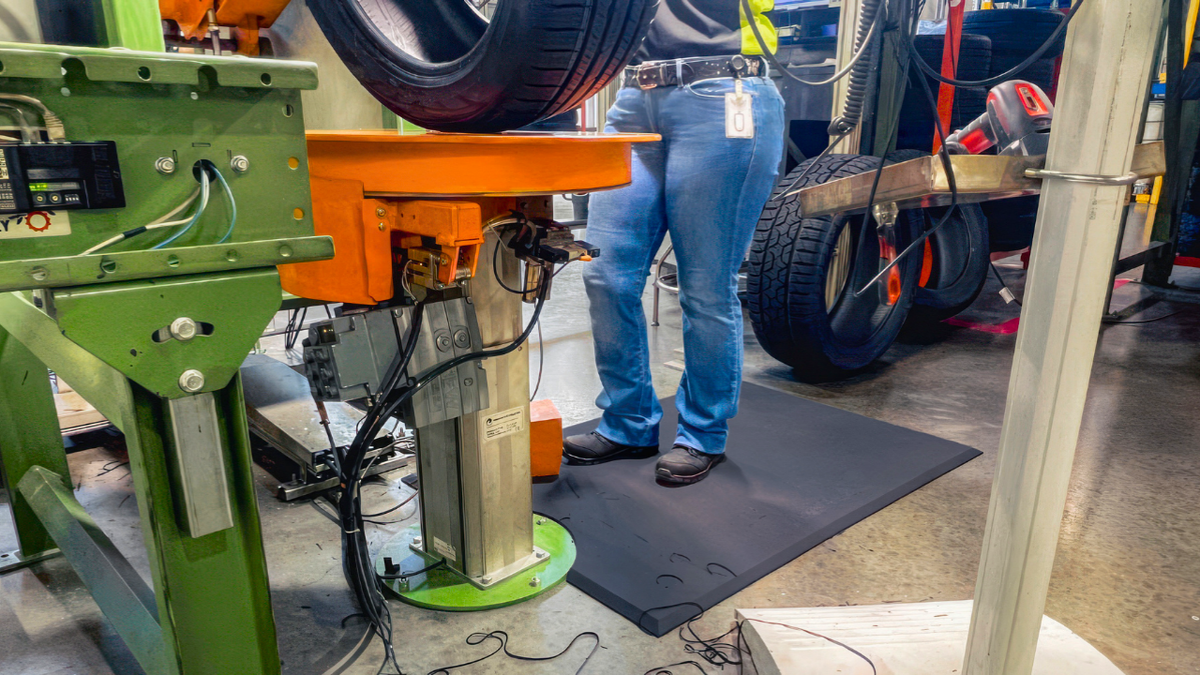
Nokian Tyres: The EHS Manager and three operators with Nokian Tyres share what it feels like to stand on AcroMat anti-fatigue mats. Note, these mats have been in use for over three years inside a 24/7 manufacturing facility.
Start With a Monthly Walk
If your facility currently has no formal anti-fatigue mat inspection process, don't overcomplicate the first step. Start with a once-a-month inspection walk.
Walk the floor yourself, or assign someone to do it themselves. Look at every mat currently in use. Talk to the people standing on the mats. Take a couple pictures. Document obvious issues. Then do it again next month.
Over time, these inspections can reveal much more than individual problems. You'll begin seeing patterns, you'll get a feel for morale, and you'll understand what's working and what isn't. These patterns can help you make better buying decisions and eventually establish a consistent anti-fatigue mat standard across your facility.
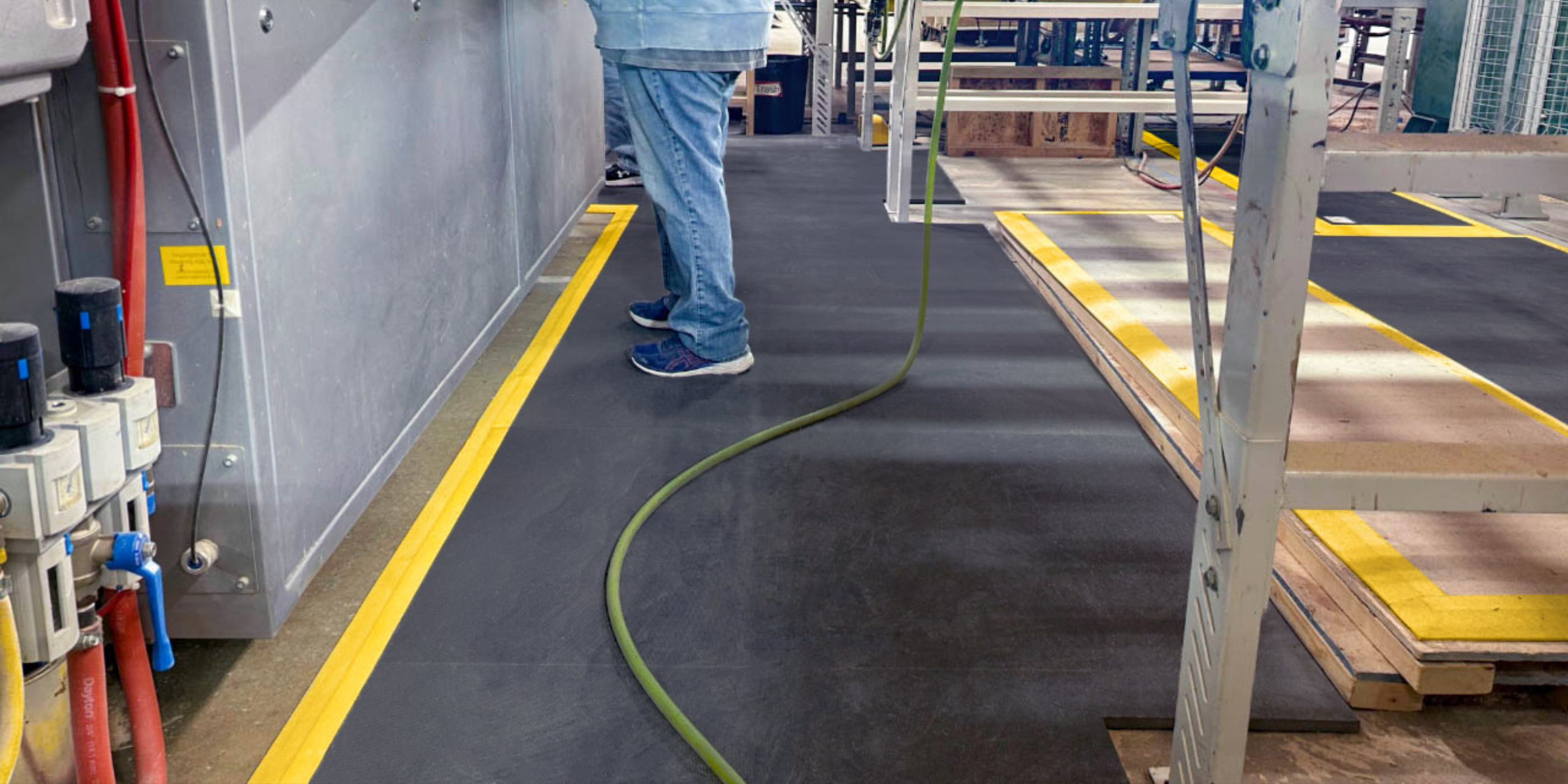
Custom AcroMat Walkthrough: Watch as a safety specialist inside this industrial manufacturing facility walks this 150 ft. custom AcroMat to see if it's still in good condition. Note, the borders are lying flat, the cushion is intact, and there are no rips or tears.
Anti-fatigue mats are designed to achieve three things: provide comfort, provide traction, and decrease the risk of slip, trip, and fall injuries. Without an evaluation process in place, it's impossible to know whether your anti-fatigue mats are helping or hurting in these areas. With an inspection process, you can ensure your mats are achieving all of the above.
Frequently Asked Questions About Anti-Fatigue Mat Inspection
How often should anti-fatigue mats be inspected?
Anti-fatigue mats should typically be inspected every 30 to 90 days. High-traffic areas and environments exposed to oils, chemicals, carts, heavy equipment, or other demanding conditions may require more frequent inspections. The most important thing is establishing a consistent inspection schedule and documenting changes over time.
How often should anti-fatigue mats be replaced?
Anti-fatigue mats should be replaced based on performance, not simply age. Consider replacement when a mat is curling, sliding, damaged, losing traction or ergonomic cushion, or no longer properly fits the workspace. A mat that continues to lie flat, provide support, maintain traction, and fit the work area may not need replacement simply because it has reached a certain age.
How long do anti-fatigue mats last?
Anti-fatigue mat lifespan varies significantly by material, environment, traffic, maintenance, and use. PVC foam mats typically last 6–12 months, PVC/nitrile blends 1–3 years, while 100% nitrile mats can have a life expectancy of up to 8 years. Actual replacement decisions should ultimately be based on how the mat is performing in its environment.
What are the signs an anti-fatigue mat needs to be replaced?
Common signs include curling or raised edges, flattening or lost cushion, tears or surface damage, lost traction, persistent sliding, separated seams, and poor fit within the workspace. Also watch for employees frequently stepping on and off the mat or standing partly on the mat and partly on the floor – an undamaged mat can still be the wrong mat for the job.
Ready to conduct an inspection? Follow our 6-step anti-fatigue mat inspection process, including freely available checklists and first-hand use cases:
Anti-Fatigue Mat Inspection in 6 Easy Steps
About the Author: Rich Ward
Rich leads the AcroMat marketing team, supports R&D, and is the architect behind the AcroMat brand. His focus is on providing clear, honest, and highly researched information to help our customers make confident buying decisions. You’ll often find Rich on industrial podcasts, LinkedIn and other channels sharing the anti-fatigue mat insight and practical tips he learns from meeting with AcroMat customers as well as researching and testing our products.