


Is it better to rent or buy anti-fatigue mats? For most facilities, buying anti-fatigue mats is more cost-effective over the long term. Renting can reduce upfront costs and may include scheduled cleaning and replacement, but recurring rental fees can cost significantly more over time. Buying requires a larger upfront investment, but gives you full ownership, more options for custom shapes and sizes, and greater control over mat performance.
That doesn't mean buying is always the right choice. Anti-fatigue mat rental can make sense for temporary needs, facilities that prioritize scheduled service, or applications where standard-size mats work well. Below, we compare the cost, fit, convenience, performance protections, and flexibility of renting vs. buying anti-fatigue mats to help you decide which approach makes the most sense for your facility.
 Comparison: Quick look at the differences between renting and buying anti-fatigue mats.
1. Anti-Fatigue Mat Rental Cost vs. Buying Cost
Renting anti-fatigue mats is less expensive in the short term, while buying anti-fatigue mats generally wins on cost over time. Renting typically involves signing a service agreement with little or no upfront investment. Instead, you pay a recurring rental fee for the duration of the agreement. Buying, on the other hand, requires a larger upfront investment, but you own the mats and eliminate recurring rental payments.
Rental Pros:
- Little or no upfront investment
- Predictable recurring expense
- Cleaning and scheduled service may be included, depending on provider
Rental Cons:
- Rental fees continue throughout the agreement
- You never own the mat (e.g., loss or damage expenses)
- Long-term rental costs can significantly exceed the cost of purchasing
For example, published Cintas contract pricing lists a 3 ft. by 5 ft. Wellness Anti-Fatigue Mat at $6.18 per week for weekly service. Actual Cintas pricing varies by customer, location, service frequency, and contract, so this should be viewed as an example rather than universal rate. This pricing also doesn't factor in the rental company's replacement/loss charges of $307.65 if a mat is damaged or lost.
At $6.18 per week, renting 10 mats would cost approximately $3,214 per year, or $16,068 over five years, assuming the rental rate remains unchanged.

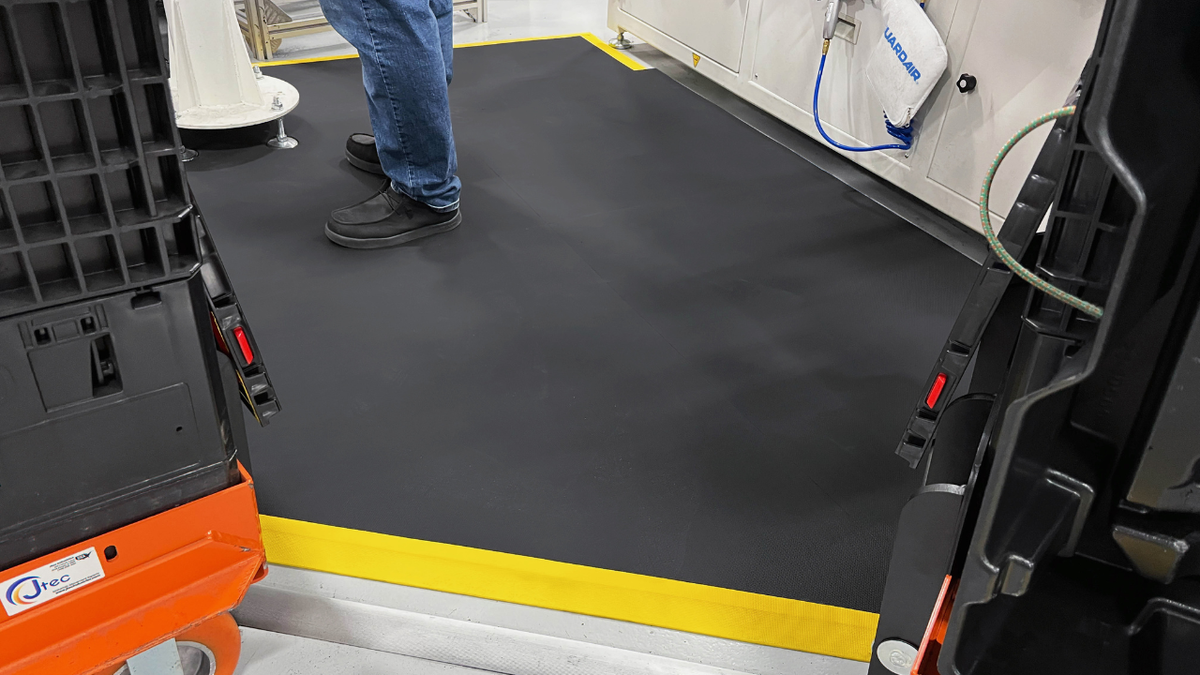
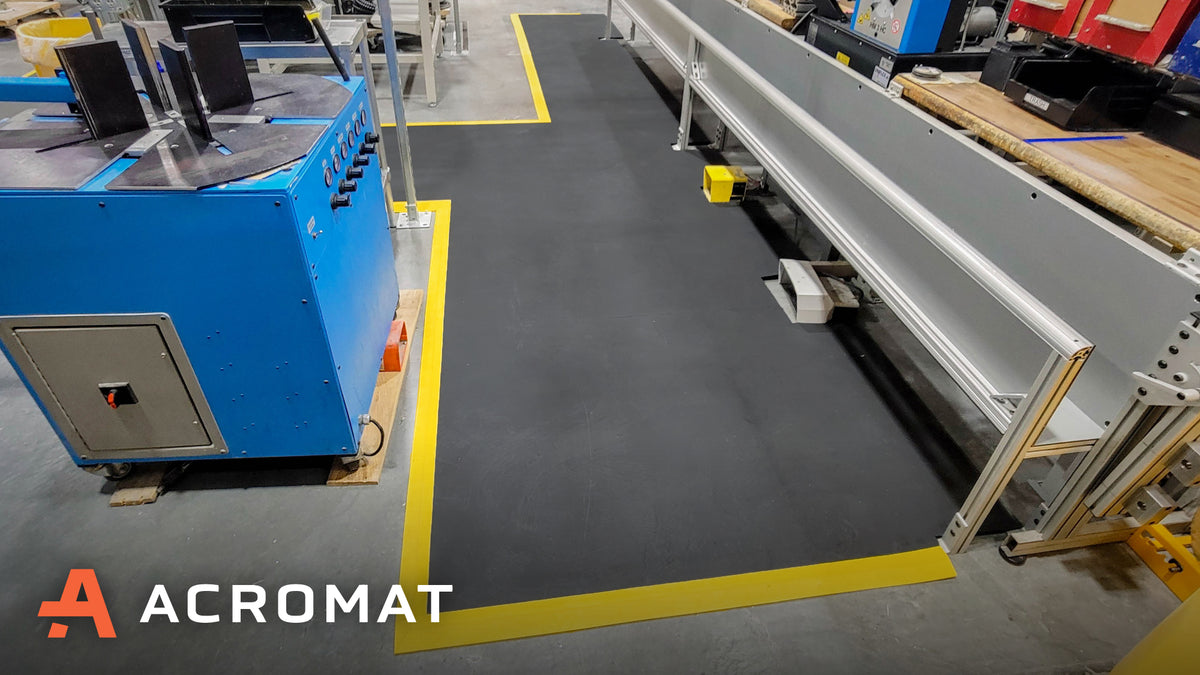
The AcroMat 100-1 Series is made from molded, 100% nitrile rubber foam. The mat can be customized to any shape and size with our mat building tool AcroSketch, and is designed to last in even the harshest industrial settings for upwards of 3–8 years.
Buying Pros:
- One-time investment
- No recurring rental charges
- Lower total cost if the mat remains in service for several years
For comparison, 10 3 ft. by 5 ft. AcroMat 100-1 Series anti-fatigue mats with yellow safety borders would cost $271 per mat, or $2,710 total upfront. AcroMat offers free shipping on orders over $1,000, so there is no additional delivery charge.
The 100-1 Series is designed to perform for 3–8 years in even the harshest industrial settings, including demanding 24/7 environments. If the mats remain in service for five years, which is the average useful lifespan, the original $2,710 investment averages out to approximately $542 per year – compared with $3,214 per year to rent 10 mats at the published Cintas rate.
Renting 5-Year Costs:
- Renting, Year 1: $3,214
- Renting, Year 2: $3,214
- Renting, Year 3: $3,214
- Renting, Year 4: $3,214
- Renting, Year 5: $3,214
- 5-Year Total: $16,068
Buying 5-Year Costs:
- Buying, Year 1: $2,710
- Buying Year 2: $0
- Buying Year 3: $0
- Buying Year 4: $0
- Buying Year 5: $0
- 5-Year Total: $2,710
In this example, renting costs nearly six times as much over five years as purchasing the same size and quantity of AcroMat anti-fatigue mats upfront.
It's important to note that AcroMat anti-fatigue mats, made from molded nitrile rubber, are on the "premium" end in terms of durability. Lesser anti-fatigue mats, like those made from extruded PVC foam, are often designed to last for 1-2 years. The rent vs. buy conversation changes if your purchasing lower-quality mats that require more frequent replacement.
2. Standard Rental Mat Sizes vs. Custom Anti-Fatigue Mats
While price is often the first consideration, fit can have an even greater impact on employee comfort, safety, and the overall performance of a workspace. In fact, 40% of the safety and production leaders we surveyed say "having to piece together rectangular mats" to try and fit complex layouts is one of their main frustrations with mats today.
When a mat doesn't fit the workspace, facilities often compensate by placing multiple mats side by side or leaving sections of bare concrete exposed. This can create:
- Uneven walking surfaces
- Frequent on/off stepping between concrete and mats
- Edge-standing and half on/half off standing
- Likelihood mats will slide around rather than remain in place

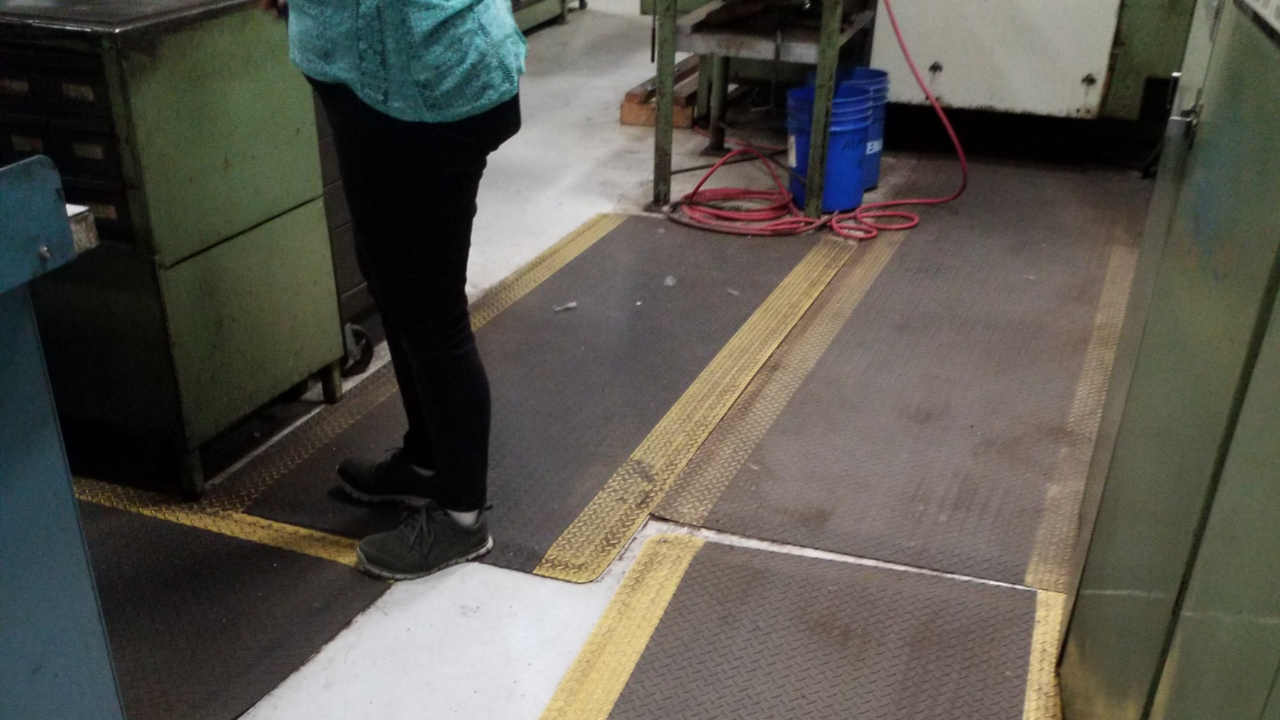
Because you are limited to a strict standard-size library, renting anti-fatigue mats often leads to the "piece and pile" approach. This approach creates preventable trip hazards, edge-standing, and encourages sliding.
Most anti-fatigue mat rental programs offer a limited selection of standard rectangular sizes, like you see pictured above – commonly 2 ft. × 3 ft., 3 ft. × 5 ft., and 4 ft. x 6 ft. mats. These sizes work well for many applications, but they don't always match the intricate layouts of manufacturing cells, assembly lines, lift tables, and other industrial workstations.
Purchasing anti-fatigue mats with AcroMat allows you to design your mats to fit the workspace instead of forcing the workspace to fit the mat. At AcroMat, customers have the ability to design their mats to any shape and size without limit. These customizations include:
- Custom lengths and widths
- L-shaped layouts
- Equipment cutouts
- Conveyor openings
- Weld-cell configurations
- Drainage sections
- Safety borders

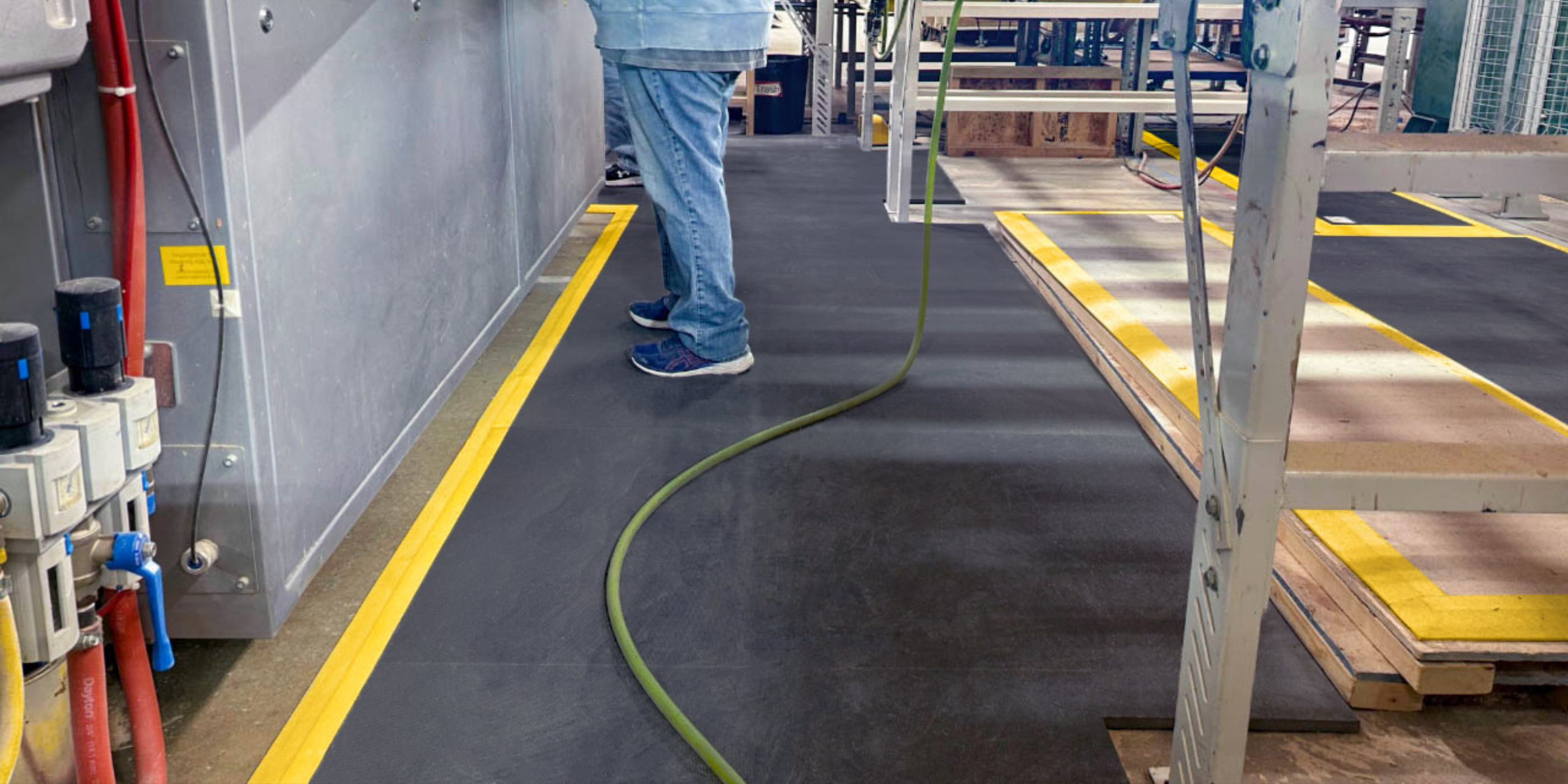
Having the ability to customize your anti-fatigue mats to any shape and size eliminates the piece and pile approach. Instead of 4-5 standard mats filling a work cell, you have just one.
Jake Berger, EHS Manager with Vermeer Corporation, shares how investing in custom anti-fatigue mats with AcroMat has eliminated the need to piece and pile mats together, and helped prevent slip, trip, and fall injuries at their 2,400-person campus in Pella, Iowa.
3. Anti-Fatigue Mat Rental Convenience vs. Ownership
This is one area where rental programs have a clear advantage. Most rental providers include scheduled pickup, cleaning, and replacement as part of their service. For businesses that don't want to manage cleaning or inventory, this convenience can be valuable.
The flip side is that most rental programs lock you into multi-year contracts. While you're receiving the convenience, you are locked into the program without room to change your mind mid-way through. Unless, like a phone plan or vehicle lease, you're willing to "upgrade," extend the contract, or pay penalty fees for ending the contract early.
Many manufacturing facilities prefer greater control over their anti-fatigue mats. Owning your anti-fatigue mats allows you to:
- Clean mats when production schedules allow
- Fully customize your mats to fit the work area
- Expand coverage as production lines change
- Avoid relying on scheduled exchange cycles
- One-time purchase, no locked-in contracts
Buying your own mats also eliminates the need to coordinate recurring service visits, which can be a hassle in large, fast-paced, multi-shift facilities where you need fewer things to plan and coordinate, not more. In this case, owning is a better fit for facilities that already manage their own housekeeping and maintenance programs, or prefer not to add to their list of to-dos.

AcroMat anti-fatigue mats are impervious to liquids and industrial-strength cleaners. This makes cleaning the mats easy and can extend the useful life by up to 1 year.
4. Rental Mat Warranties vs. Purchased Mat Warranties
When renting anti-fatigue mats, because you don't own the product, your protections are determined by the terms of your rental contract. Before signing, it's important to understand what happens if a mat curls, loses its cushion, comes apart, or stops performing in other ways. In most cases, rental mats are designed for short-term use and come with 3-6 month warranties. These short-term warranties are primarily manufacturing guarantees, promising the mats will be made without defect rather than guaranteeing "how" they will perform.
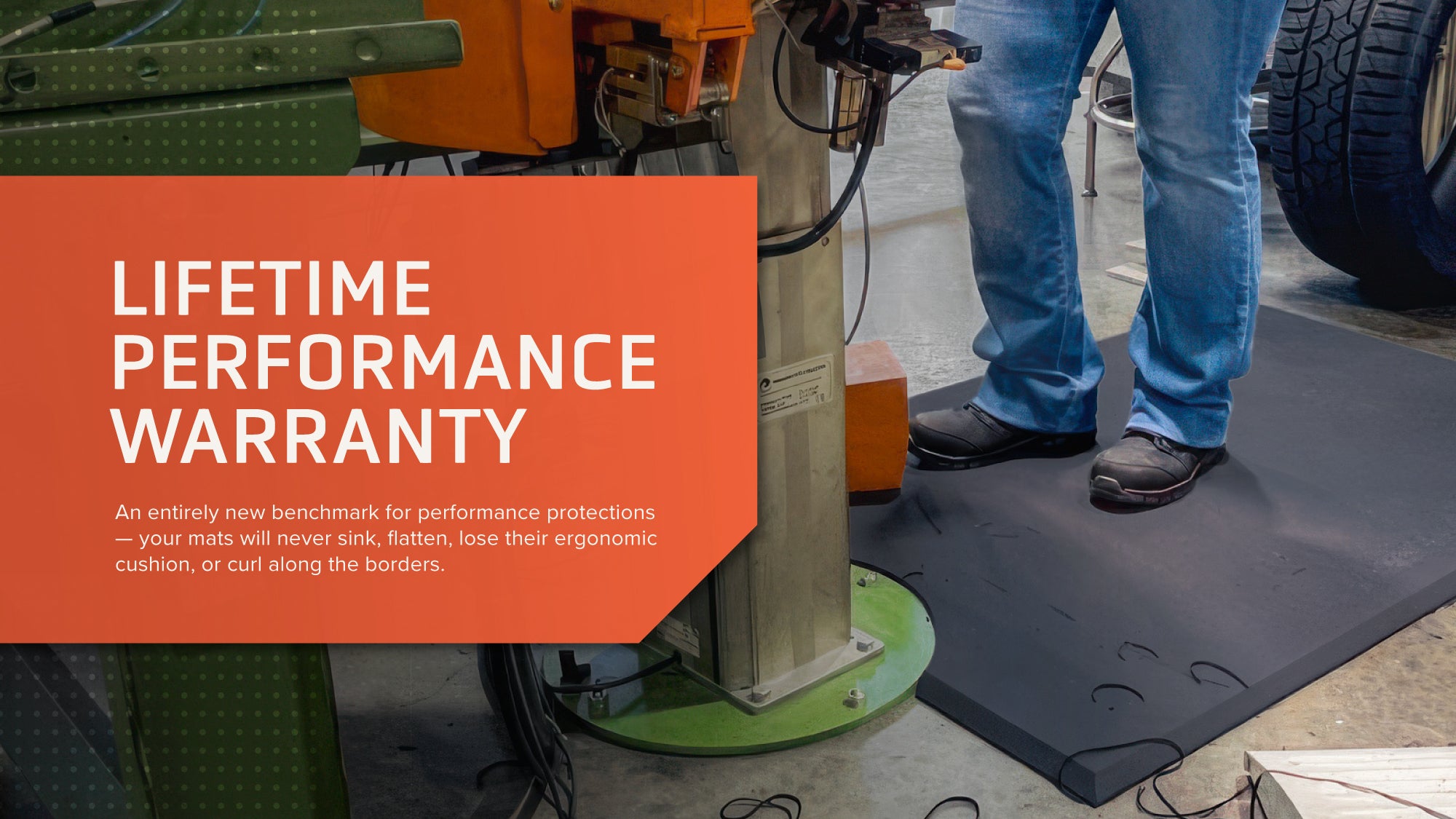
Purchasing allows you to choose a mat based not only on its performance, but on the warranty protecting that performance. For example, AcroMat's flagship 100-1 Series, 100-ESD Series, and 100-Cleanroom Series mats are backed by a Lifetime Performance Warranty. The warranty guarantees the mats will never curl along the borders or sink, flatten, or lose their ergonomic cushion. If they do, AcroMat will replace them.
Regardless of whether you rent or buy, look closely at what performance protections you're receiving. Upfront cost means much less if you're protected in key areas for years at a time. It means much more if you're responsible for replacing mats as soon as they stop performing.
Barry Setzer, Mill Supervisor at Titans of CNC, shares why AcroMat's Lifetime Performance Warranty led his team to replace all of their mats with AcroMat anti-fatigue mats.
Related: The Problem With Your Anti-Fatigue Mat Warranty
5. Buying Gives Your More Options to Customize and Improve
One overlooked difference between renting and buying anti-fatigue mats is your ability to modify mats to better fit your environment. For example, supplementing your mats to prevent a highly common, dangerous issue like sliding.
When renting, you're generally limited to the product and features offered through the rental program. If sliding becomes a problem, there isn't much you can do other than taping mats to the floor. Tapes can look unseemly and easily peel, potentially creating another safety issue.
Purchasing gives you greater flexibility to address the problem directly. For example, with AcroMat, customers can choose whether to have our non-slip coating Grip-R pre-applied to the bottom of their mats. Grip-R dries to the bottom of the mat and creates a firm bond between mat and floor to prevent sliding. Non-slip backings like Grip-R are not available with rental mats, because the contract needs your mats back the way they were provided.
Being able to supplement your mats is particularly valuable in fast-paced, busy environments where floor conditions vary from workstation to workstation. Rather than simply accepting a mat that slides around, purchasing gives you control over the mat and how it performs.
See how Grip-R Non-Slip Coating prevents anti-fatigue mat movement in this short video. In the Vermeer case study above, EHS Manager Jake Berger and his team members also discuss the impact Grip-R has had on safety inside their facilities.
Should You Rent or Buy Anti-Fatigue Mats?
Both rental and purchasing have their place.
Renting anti-fatigue mats may be the better option if:
- You only need mats for a temporary project or facility.
- You're comfortable replacing your mats every 3-6 months.
- You value scheduled cleaning and replacement services.
- Standard rectangular sizes meet your needs.
- Keeping upfront costs low is your highest priority.
Buying anti-fatigue mats is typically the better option if:
- Employees stand at the same workstations every day.
- You expect to use the mats for several years.
- Your workstations require custom sizes or shapes.
- You want the lowest total cost of ownership.
- You value long-term ergonomic performance and consistency.
For most manufacturing facilities, warehouses, laboratories, and distribution centers, purchasing anti-fatigue mats is the better long-term decision. Although rental programs reduce upfront costs and simplify cleaning, they also create ongoing expenses, limit customization, and leave you without ownership.
Before settling for either approach, it's important to weigh your needs against what your mat providers are offering. Look closely at features like shape/size options, warranty protections, upfront cost, contract length, and the sample program.
Interested in comparing AcroMat to the anti-fatigue mats you use now? Contact our team any time for a free sample you can keep and put to the test.
About the Author: Rich Ward
Rich leads the AcroMat marketing team, supports R&D, and is the architect behind the AcroMat brand. His focus is on providing clear, honest, and highly researched information to help our customers make confident buying decisions. You’ll often find Rich on industrial podcasts, LinkedIn and other channels sharing the industrial marketing and anti-fatigue mat insight and practical tips he learns from constantly researching, testing and trialing our products.